Types of Heels: The Complete Style Guide
Most heel-shopping mistakes come from one confusion: treating heel height and heel shape as the same thing. A 3-inch block heel and a 3-inch stiletto carry your body weight in completely different ways, even though they measure identically on a ruler. That gap between what a heel looks like on a spec sheet and how it actually feels underfoot is why searches for "types of heels" so often turn up name lists without any real guidance on which one to buy.
This guide separates heel shape from heel height, walks through the 12 styles you're most likely to encounter while shopping, and backs the comfort claims with forefoot-pressure research rather than guesswork. Use the comparison table to match a heel type to your occasion and comfort tolerance, then read the sections that apply to your foot shape and wardrobe.
TL;DR
There are 12 common heel styles, and each one is defined by heel shape, not by how tall it is. Height is a separate variable that layers on top of shape.
Stilettos and kitten heels sit at opposite ends of the comfort-versus-drama spectrum. Block and wedge heels offer the most stability for all-day wear.
A 2-inch heel increases forefoot pressure by about 57% over flat shoes, and a 3-inch heel by about 76% (Speksnijder et al., The Foot, 2005). Shape, not just height, decides how wearable a style actually is.
Use the comparison table below to match a heel type to your occasion, foot shape, and comfort tolerance before you shop.
What Actually Defines a "Heel"? (Shape vs. Height)
A heel type is defined by its structural shape, not by how tall it is. Height is a separate, independent variable that layers on top of shape, which is why two heels of identical height can feel completely different to walk in.
Every heeled shoe is built from three working parts. The heel itself is the raised block, cone, or spike under the back of the foot. The shank is a rigid strip, usually steel or fiberglass, that runs under the arch and keeps the shoe from collapsing under body weight. The toe box is the front chamber that holds the toes and determines how much room they have on each step. A stiletto concentrates the entire body weight onto a heel tip roughly the width of a coin. A block heel spreads that same weight across a base several times wider. Both can be 3 inches tall. Only one of them will feel stable on an uneven floor.
This is the distinction most heel guides skip. General "types of heels" roundups tend to list styles by name without separating what actually makes each one comfortable or unstable, so height and shape blur together by default. Once you separate the two, shopping gets easier: you can ask for "a low block heel" or "a low stiletto" and get a genuinely different shoe each time, instead of assuming a lower heel automatically means a more comfortable one.

The 12 Most Common Heel Types, Compared
The clearest way to compare heel types is side by side, because names alone (kitten, cone, mule) don't tell you how a heel behaves on your foot. The table below breaks down all 12 common heel styles by height range, stability, and the occasions each one actually suits.
| Heel Type | Height Range | Stability | Best For |
|---|---|---|---|
| Stiletto | 3-5 in | Low | Formal evenings, parties |
| Block | 1.5-3.5 in | High | Office, all-day wear |
| Kitten | 1-2 in | High | First-time heel wearers, office days on your feet |
| Wedge | 1.5-4 in | High | Outdoor events, daytime functions |
| Platform | 3-6 in | Medium | Nightlife, statement dressing |
| Slingback | 2-4 in | Medium | Weddings, semi-formal daytime events |
| Peep-Toe | 2-4 in | Medium | Cocktail parties, festive daywear |
| Ankle-Strap | 2-4 in | Medium | Dancing, events with a lot of standing |
| Mule | 1-3 in | Low | Errands, brunch, short-stretch dressing |
| Cone | 2-3 in | Medium | Transitioning up from kitten heels |
| Boot Heel (Chunky) | 1-3 in | High | Daily wear, cooler-weather styling |
| Embellished / Ethnic | 2-4 in | Medium | Weddings, festive and bridal wear |
Here's what separates each style in practice.
Stiletto Heels
Stiletto heels are defined by a thin, narrow heel tip, typically under a centimeter wide, tapering from a slim shaft. Height usually runs 3 to 5 inches. Because the entire heel strike lands on that narrow point, stilettos carry the highest forefoot pressure of any style in this guide (see the height and comfort data below) and rate lowest for stability. They suit formal events measured in hours, not full days: weddings, evening parties, and dressed-up nights out.
Block Heels
Block heels use a heel piece that stays roughly the same width from top to bottom, usually square or rectangular in cross-section. Height ranges widely, from a low 1.5 inches to a statement-making 3.5 inches, but the wide base keeps ground contact stable at every height in that range. Block heels rate highest for stability in this guide's comparison, which is why they dominate office and all-day-wear recommendations.
Kitten Heels
Kitten heels are short, typically 1 to 2 inches, with a slim, slightly curved heel shaft. The combination of low height and a shorter heel keeps forefoot pressure closer to flat-shoe levels than any other heeled style, which is why kitten heels are a common recommendation for first-time heel wearers and for office days that involve a lot of walking.
Wedge Heels
Wedge heels replace a distinct heel piece with a solid, triangular sole that runs from heel to arch, distributing weight along the length of the foot instead of concentrating it at one point. Heights run from 1.5 to 4 inches. That continuous sole contact is why wedges rate as stable as block heels even at greater heights, and why they show up so often in daytime outdoor event recommendations, including garden weddings and daytime festive functions.
Platform Heels
Platform heels add a thick sole layer under the ball of the foot, which reduces the effective incline between the front and back of the shoe even at heights of 3 to 6 inches. That front lift makes a very tall platform feel less steep than a stiletto at the same overall height, but the added sole thickness introduces its own underfoot stability trade-off, so this guide rates platforms medium rather than high. They suit nightlife and statement dressing more than long stretches of walking.
Slingback Heels
Slingback describes strap position, an open back held by a strap around the ankle, not the heel shape itself. Slingbacks are usually built on a mid-height heel of 2 to 4 inches, most often stiletto or block. The open heel adds ventilation and a dressier silhouette, at a small stability cost compared with a fully enclosed back. They work well for weddings and semi-formal daytime events.
Peep-Toe Heels
Peep-toe heels leave the front of the toe box open, showing the first one or two toes, typically on a 2- to 4-inch heel. Like slingbacks, the defining feature is coverage, not the underlying heel shape, so comfort and stability depend heavily on which heel type sits underneath the open toe. Peep-toes suit cocktail parties and festive daywear, where a fully closed-toe look would read too formal.
Ankle-Strap Heels
Ankle-strap heels add a strap across or around the ankle, which does something none of the open styles above can: it locks the foot to the footbed and meaningfully reduces slippage, especially at heights of 2 to 4 inches. That extra anchor point is why ankle straps often feel more secure than an equivalent height without one, even without an inherently wider heel base.
Mule Heels
Mules have no back strap or heel counter at all. The foot slides in and the back stays fully open, usually on a 1- to 3-inch heel. The trade-off for that slip-on convenience is stability: without anything anchoring the heel in place, mules rate low on this guide's stability scale regardless of how low the heel itself sits. They're best suited to short stretches, like errands, brunch, or low-commitment dressing.
Cone Heels
Cone heels taper from a wider base at the sole to a narrower point at the ground, splitting the difference between a stiletto's spike and a block heel's flat base. At 2 to 3 inches, the wider top gives more underfoot support than a stiletto at the same height, which is why cone heels often get recommended as a step-up style for someone moving on from kitten heels.
Boot Heel (Chunky Heel)
Boot heel, sometimes called a chunky heel, describes a short, wide heel typically built into ankle boots and booties rather than sold as an open shoe, usually 1 to 3 inches. The wide, low profile behaves similarly to a block heel and rates high for stability, which is part of why heeled boots are a common daily-wear recommendation through cooler months.
Embellished and Ethnic Heels
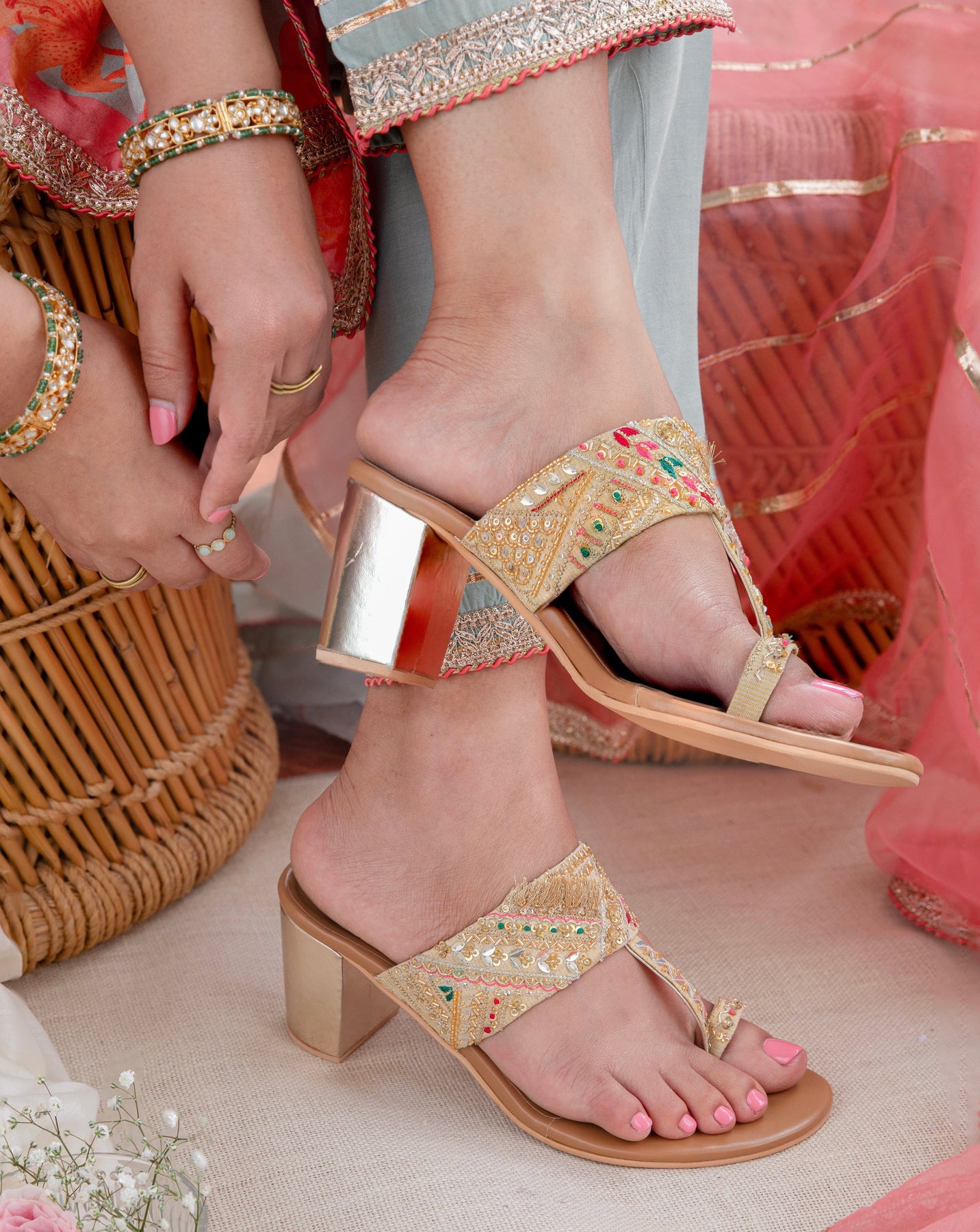
Embellished and ethnic heels describe finish and detailing, such as crystal work, zari embroidery, or kolhapuri-style leatherwork, applied over an underlying heel shape, most often a block or wedge base in festive and bridal collections. Because the embellishment sits on top of a structural shape rather than replacing it, stability still depends on that base heel, which is one more reason the shape-versus-height distinction from earlier in this guide matters when shopping for wedding or festive footwear.
Getting these distinctions right matters more in India specifically, because women's footwear is not a small or shrinking category. Women's footwear held roughly 42% of the Indian footwear market in 2024 and is projected to remain the largest segment through 2026 (IMARC Group, India Footwear Industry). The women's luxury footwear segment, which includes heels and pumps, is projected at roughly USD 1,456.3 million in 2025 (Future Market Insights, India Women's Luxury Footwear Market). Knowing the vocabulary above isn't just a shopping nicety; it maps directly onto how a large share of India's footwear market actually gets searched and bought. If you already know you want a shape built for comfort over a full day, you can skip ahead to our full guide to all-day-comfortable heels.
Heel Height and Comfort: What the Research Actually Shows
Every inch of heel height meaningfully increases the pressure on the front of the foot, and the increase isn't small. Podiatric research measuring forefoot pressure at different heel heights found that pressure climbs by roughly 22% at 1 inch, 57% at 2 inches, and 76% at 3 inches, compared with flat shoes (Speksnijder CM et al., "The higher the heel the higher the forefoot-pressure in ten healthy women," The Foot, 2005, 15(1):17-21).
The study measured forefoot pressure in ten healthy women wearing shoes at three heel heights: about 2.5 cm (1 inch), 5 cm (2 inches), and 7.5 cm (3 inches). Pressure rose at every increment, and the increase wasn't linear: moving from 1 inch to 2 inches nearly doubled the forefoot-pressure increase itself, from 22% to 57%. The original paper sits behind a publisher paywall (ScienceDirect record); the figures above were corroborated consistently across independent secondary summaries of the same study and its citation record, but a direct read of the primary PDF is preferable for anyone with institutional journal access.
Pair this pressure data with wear duration, not just the outfit, when deciding how high to go. A 3-inch heel that's fine for a two-hour dinner can turn genuinely uncomfortable across an eight-hour wedding function, because the pressure increase compounds with time on your feet, not just with height.
- Under 2 hours (dinner, a quick event): most heights work fine if the shape suits your foot.
- 2 to 5 hours (an office day, a reception): 1- to 2-inch block, kitten, or wedge heels hold up best.
- 5 or more hours (full-day wedding functions, festivals): stay under 2 inches, and favor a block or wedge base.
For a deeper breakdown by shoe, see our shoe-by-shoe comfort breakdown.
How to Choose the Right Heel for Your Occasion
Match heel type to occasion first, comfort tolerance second, and outfit color or print last. Getting the order right makes the rest of the decision much easier.
For office and daily wear, kitten, block, and low wedge heels handle repeated standing and walking without the pressure spike that comes with a taller, narrower heel. For weddings and festive functions, the right choice depends on how long you're actually on your feet: a block- or wedge-based embellished heel holds up across a full day of functions, while a platform or slingback stiletto works well for an evening-only event where you're seated more than you're standing. For casual outings, wedge, mule, and low block heels balance ease of wear with a dressed-up look. For formal, shorter events, stiletto, slingback, and peep-toe heels earn their place because drama matters more than duration.
Indian wedding and festive dressing adds a category most Western heel guides skip entirely: multi-day functions where the same pair of heels has to work across a sangeet, a daytime haldi, and an evening reception. For that stretch, a block- or wedge-based embellished heel is the safer structural choice, not because the embellishment matters less, but because the base heel shape decides how your feet hold up across three or four consecutive events. Mismatched footwear is also one of the more common footwear pairing mistakes that show up with ethnic outfits, and it's usually a heel-shape problem more than a style problem.
Choosing the Right Heel for Your Foot Shape and Comfort Level
Foot shape and arch type change which heel shapes feel stable, independent of the height printed on the box.
Wide feet generally do better in block, wedge, or boot-heel styles, where the base width matches the foot instead of tapering to a narrow point; a pointed-toe stiletto or cone heel tends to feel tightest exactly where a wider foot needs the most room. Narrow feet often slip inside open styles, so an ankle-strap or slingback that locks the foot to the footbed helps more than a fully backless mule, which relies on the foot staying put on its own. High arches benefit from a proper shank and a defined heel-to-toe structure; a block or wedge distributes weight more evenly across the arch than a flat, structureless mule does. Beginners are best served starting under 2 inches in a kitten or block heel and working up gradually, while experienced heel-wearers can handle a stiletto or platform for the shorter stretches those styles are built for.
- High stability: 4 of 12 types (33%): block, kitten, wedge, boot heel
- Medium stability: 6 of 12 types (50%): platform, slingback, peep-toe, ankle-strap, cone, embellished/ethnic
- Low stability: 2 of 12 types (17%): stiletto, mule
Styling and Pairing Guide
Toe shape and heel shape should be paired deliberately, not decided by height and outfit color alone.
For ethnic wear, a rounded or almond toe on a block or wedge heel keeps the outfit's proportions balanced under a lehenga or sharara, while a pointed peep-toe or slingback works better under a saree or fitted kurta, where more of the foot shows. For western wear, a stiletto or cone heel elongates the leg line under tailored trousers or a fitted dress, while a chunky boot heel pairs naturally with denim and casual layering. For workwear, block and kitten heels stay the most practical choice across a full day of meetings and commuting. It's also worth knowing how heels stack up against other footwear categories: for a direct comparison, see how heels compare to juttis and sandals.
Color trends shift season to season, but the shape-and-occasion logic above doesn't. If you're investing in a pair meant to last several seasons, it's worth knowing the heel brands worth knowing before you commit to a specific silhouette.

Caring for Your Heels So They Last
Most heel damage comes from storage and sole wear, not the heel structure itself.
Store heels with a shoe tree or stuffed toe box to hold their shape, and avoid stacking pairs directly on top of one another, since the weight can bend a thin heel or crease a soft upper over time. Add a rubber sole guard to the parts of the sole that touch the ground first, and rotate between at least two pairs during a heavy-wear week so a single pair isn't absorbing all the impact. Leather and embellished heels need a slightly different routine: condition leather uppers periodically to keep them from drying and cracking, and spot-clean embroidery or beadwork instead of exposing it to a full wash, since excess moisture is one of the fastest ways to loosen embellishment. For a complete routine, see how to care for leather and embellished heels.
Frequently Asked Questions
Which type of heel is most comfortable for daily wear?
Block and wedge heels are generally the most comfortable for daily wear, because their wider base distributes weight instead of concentrating it on a narrow point, the same stability pattern shown in the comparison table above.
What heel height is best for beginners?
1 to 2 inches is the safest starting height for beginners, based on the forefoot-pressure research above: at that range, pressure sits closest to flat-shoe levels, and shapes like kitten and block heels reinforce that low height with a stable base.
Can stilettos be worn all day?
Stilettos aren't a good fit for a full day on your feet. At 3 inches, forefoot pressure runs about 76% higher than flats (Speksnijder et al., 2005), and a stiletto's narrow heel tip adds a stability cost on top of that, which is why this guide reserves them for events measured in hours, not full days.
What's the difference between a pump and a stiletto?
A pump and a stiletto describe different things. "Pump" refers to toe and vamp coverage: a closed-toe, low-cut slip-on shoe with no ankle strap or lacing. "Stiletto" refers to heel shape: a thin, tapered heel. A shoe can be a pump built on a stiletto heel, but it can just as easily be a pump on a block or kitten heel, which is a distinction the source material this guide replaces routinely blurred together.
Which heels pair best with ethnic or Indian formalwear?
Block and embellished ethnic heels pair best with Indian formalwear for anything longer than a couple of hours, because the wider base underneath the embellishment holds up across multi-function events like weddings and festivals, where a stiletto's narrow heel tip tires out faster.
How do I care for leather or embellished heels long-term?
Leather and embellished heels last longest with dry storage, a shoe tree or stuffed toe box to hold their shape, and spot-cleaning instead of a full wash near beadwork or embroidery. See our complete leather and embellished heel care routine for step-by-step instructions.
Heel shape decides comfort and stability. Heel height decides drama and formality. Once you separate the two, and use them to answer different questions instead of one blended one, choosing a pair gets a lot less guesswork: match the shape to your occasion and wear duration first, then pick the height that suits the outfit.
The comparison table and the forefoot-pressure data above are meant to be reference points you come back to, not a one-time read. Bookmark the section that matches whatever you're shopping for this week, whether that's a first pair of kitten heels or a full wedding-function lineup.
Pastels & Pop's full heels collection is organized by shape and height using this same framework, so it's built to match. Shop the collection when you know what you're looking for.
Leave a comment